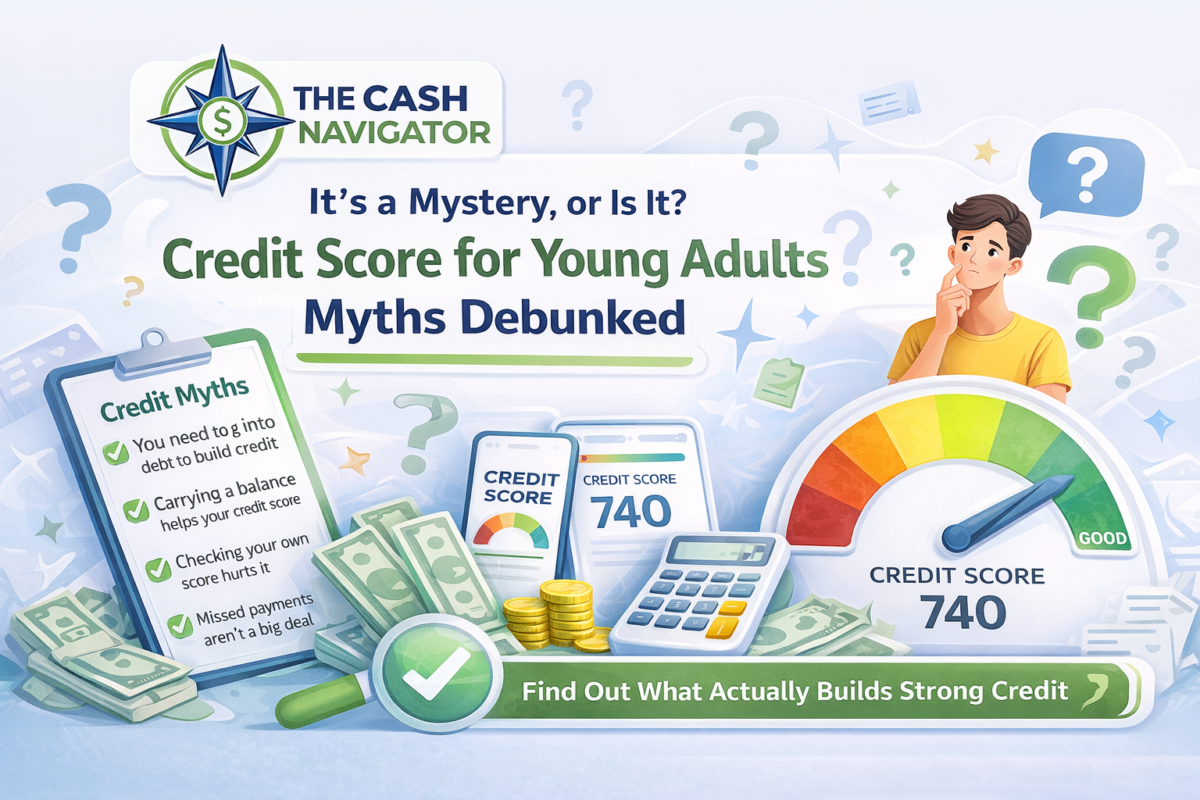
Credit scores are one of the most misunderstood parts of personal finance — especially for young adults who are just starting to build theirs. Bad information leads to bad decisions. Here are nine myths that trip people up, and the truth behind each one.
Myth 1: Checking your own credit score hurts it
False. Checking your own credit score is a "soft inquiry" and has zero impact on your score. Only "hard inquiries" — when a lender checks your credit for a loan or credit card application — can temporarily lower your score by a few points. Check your score as often as you want. You should be monitoring it regularly.
Myth 2: You need to carry a balance to build credit
False. This is one of the most expensive myths in personal finance. Carrying a balance means paying interest — sometimes 20–29% APR. You build credit by using your card and paying the full balance every month. The card issuer reports your on-time payment to the credit bureaus regardless of whether you carry a balance.
Myth 3: Closing old credit cards improves your score
Usually false. Closing a credit card reduces your total available credit, which increases your credit utilization ratio — and that can lower your score. It also shortens your average account age over time. Unless the card has a high annual fee you're not getting value from, keeping old cards open (even unused) is usually better for your score.
Myth 4: Income affects your credit score
False. Your income is not part of your credit score calculation. Credit scores are based on payment history, amounts owed, length of credit history, new credit, and credit mix. A high earner with missed payments has a worse score than a low earner with perfect payment history.
Myth 5: You only have one credit score
False. You have dozens of credit scores. The three major bureaus (Equifax, Experian, TransUnion) each calculate their own score, and there are multiple scoring models (FICO 8, FICO 9, VantageScore 3.0, etc.). The score you see in a free app may differ from the score a lender pulls. What matters is the general range — not the exact number.
Myth 6: Debit cards build credit
False. Debit card usage is not reported to credit bureaus. Only credit products (credit cards, loans, lines of credit) build credit history. If you want to build credit, you need at least one credit account being reported.
Myth 7: A bad credit score is permanent
False. Credit scores change every month as new information is reported. Most negative items (late payments, collections) fall off your report after 7 years. Bankruptcies stay for 10 years. But you can start improving your score immediately by paying on time and reducing utilization — you don't have to wait for negatives to fall off.
Myth 8: You need a perfect 850 to get the best rates
False. Most lenders offer their best rates to anyone above 740–760. The difference between a 760 and an 850 is usually negligible in terms of loan rates. Focus on getting above 720 — that's where the meaningful rate improvements happen.
Myth 9: Applying for one credit card won't affect your score
Partially true, but misleading. A single hard inquiry typically drops your score by 5 points or less, and the effect fades within a year. But applying for multiple cards in a short period stacks those inquiries and signals financial stress to lenders. Apply for new credit strategically — not impulsively.
How to actually build credit as a young adult
- Open a secured or student credit card
- Use it for one small recurring expense (like a streaming subscription)
- Pay the full balance every month — never miss a payment
- Keep utilization below 30% (ideally below 10%)
- Don't apply for multiple cards at once
- Monitor your score monthly with a free tool
Track the numbers that matter: The 3 Financial Numbers Every College Student Needs to Track.