If you're searching how to start a business with no money, you're not alone—and you're not "behind." In 2026, a lot of people are trying to build income outside of a single paycheck because prices are still high, borrowing is still expensive, and job security can shift quickly.
The good news: it is possible to launch a legitimate business without a big startup budget. The bad news: doing it the wrong way (buying tools before you have customers, using debt as a substitute for demand, or skipping the basics) can turn a "side project" into a financial stress machine.
This guide is built for today's conditions. You'll learn a proven path for how to start a business with no money: pick a cash-flow-first offer, validate demand before spending, get your first paying customers, and build simple systems that keep you compliant and in control.
Quick summary: Start with an offer people already pay for, sell it before you build it, keep overhead near $0, and reinvest early profit into the few tools that increase speed and quality.
Why this matters in 2026
In a higher-interest-rate environment, "just borrow the startup money" is no longer casual advice. Debt is more expensive, and early revenue is not guaranteed. That's why more founders are searching how to start a business with no money—because the safest startup capital is often earned revenue, not borrowed money. For context, the Federal Reserve has held the federal funds rate in a higher target range in 2026, and official inflation data shows prices are still rising year-over-year.
The data supports the bigger trend: the U.S. Census Bureau reports hundreds of thousands of business applications each month, showing that entrepreneurship remains active even when the economy feels uncertain.
Meanwhile, consumer affordability pressures haven't vanished just because inflation cooled. That's one reason service-based, problem-solving businesses are winning right now: when people feel squeezed, they still pay for outcomes that save time, reduce stress, or protect essentials.
What "no money" really means
Let's be honest: most businesses require something. If it's not cash, it's time, effort, skill, relationships, or consistency. When people ask how to start a business with no money, what they usually mean is: "How do I start without taking on debt or draining my savings?"
No money does not mean no plan. You still need a clear offer, basic operations, and a way to get paid.
Here is the mindset shift that makes or breaks zero-capital entrepreneurship: Stop building and start selling. If you can't sell a basic version of the offer, spending money won't fix the problem. Selling is the validation.
The best business models when you have $0
The easiest businesses to start with no capital share three traits: low overhead, fast time-to-cash, and a clear connection between work and revenue.
Cash-flow-first service businesses
Services are the simplest "zero capital" model because you sell your skill and time before you ever need inventory. Examples include: local cleaning, mobile car detailing, tutoring, bookkeeping support, resume writing, basic web design, content editing, handyman help, pet services, lawn care, and administrative support for other small businesses.
Productized services
A productized service is a service with a fixed deliverable and a fixed price (or a small menu of packages). It's a powerful approach because it simplifies marketing and reduces custom work. Example: "$199 Google Business Profile setup for local contractors" or "$299 resume + LinkedIn refresh."
Reselling and flipping
This is often "low money" rather than "no money," but you can start by selling items you already own. The big advantage is that you learn pricing, negotiation, listing, customer communication, and cash handling—core business muscles.
Digital assets (later, not first)
Digital products, courses, and subscription communities can work, but they usually take longer to generate cash. In today's market, it's often smarter to start with a service to create income and audience, then productize later.
Step-by-step: launch with $0
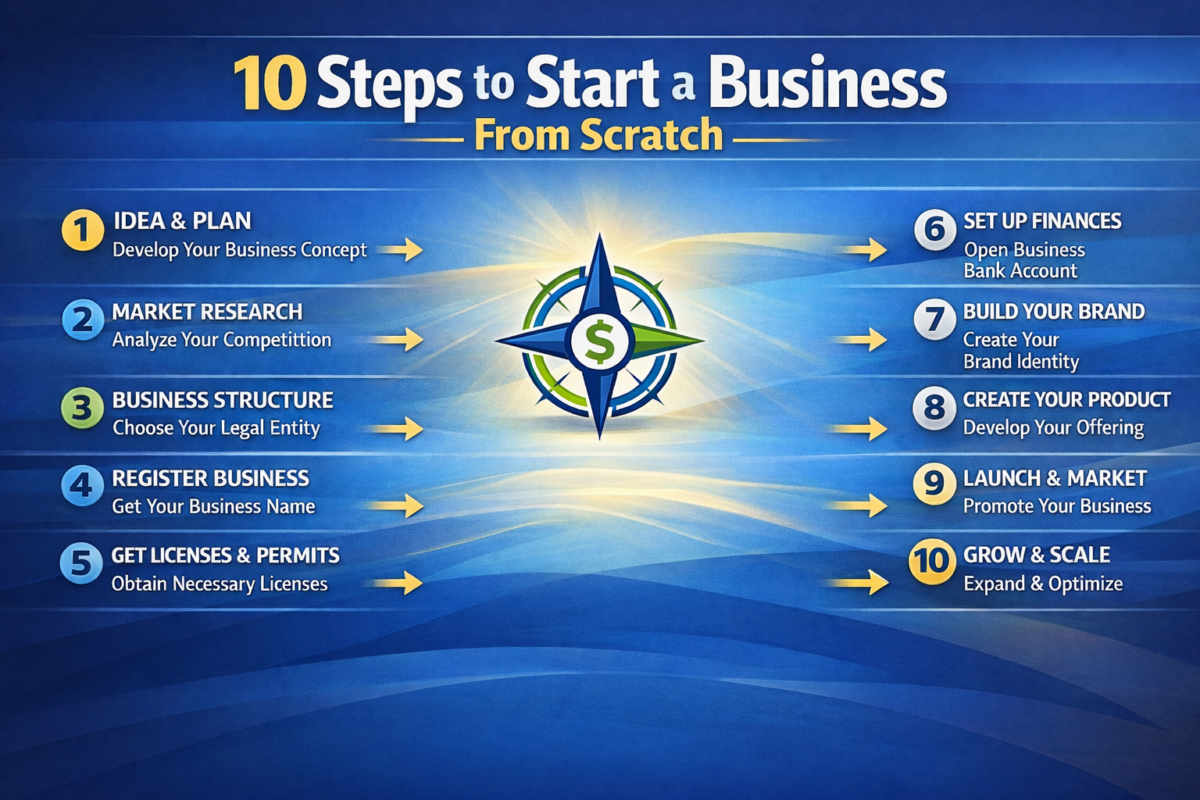
This section is the practical checklist for how to start a business with no money. It follows a lean sequence adapted for "no budget" founders.
Pick an offer that solves an expensive problem
Look for problems people already pay to solve: saving time, reducing stress, maintaining a home or car, improving income, or meeting compliance needs.
A quick filter: can you explain the offer in one sentence, and can someone buy it within 7 days?
Validate before you build
Validation is not likes. Validation is a "yes" with a calendar date and payment. To do this with $0:
- Message 20–30 people in your network with a clear offer and a clear result.
- Post a simple service offer to local community groups (follow their rules).
- List the offer on a marketplace that already has buyers (instead of building a website first).
- Offer 3 "beta slots" at a lower price to collect reviews and refine delivery.
If nobody bites, don't take it personally—adjust the offer (result, niche, price, promise) and test again. This iterative loop is the real skill behind how to start a business with no money.
Get paid early (deposits, packages, or pre-sells)
If you have no startup funds, your first customer is your seed investor. The cleanest options:
- Deposit: 30%–50% up front to book time.
- Package: paid weekly or monthly for a defined deliverable.
- Pre-sell: sell a limited number of slots for a service you deliver next week.
Deliver manually before you automate
New founders often overspend on software subscriptions. Start with manual delivery: Google Docs, spreadsheets, and simple invoicing. When the business proves it can earn, then you upgrade tools.
Turn the first 30 days into proof
Your first mini-goal is not a logo. It's proof: 3 paying customers, 3 testimonials, and a simple repeatable process. Once you have that, you have a real foundation.
Free and low-cost tools to run your business
You can run a surprising amount of business operations on free tools. Keep it simple until revenue proves what to buy.
Communication and scheduling
- Email: start with a free inbox, then move to a domain-based email once you have consistent clients.
- Scheduling: use a free booking link or a shared calendar.
- Client intake: a simple online form + a standard set of questions.
Tracking money
- Spreadsheet cash tracker: revenue, expenses, profit, taxes set aside.
- Receipt folder: cloud storage with a monthly folder system.
- Budget discipline: a personal budget keeps the business from becoming financial chaos.
Legal, banking, and tax basics (without overwhelm)
The fastest way to destroy a "no money" business is to create a tax or legal mess you can't afford to clean up. The goal is not complexity—it's separation and compliance.
Choose a business structure intentionally
Your business structure influences taxes, day-to-day operations, and how much of your personal assets are at risk. Not everyone needs an LLC on day one, but everyone should understand when risk and credibility make it worth it.
Use the IRS checklist to avoid rookie tax mistakes
The IRS provides a practical checklist of steps for starting a business. Use it as a guardrail so you don't miss basics like recordkeeping and state requirements.
Separate business money from personal money early
Even if you start as a sole proprietor, build separation: a dedicated bank account (as soon as possible), a dedicated payment method, and simple bookkeeping.
If debt is currently squeezing your monthly cash flow, check your numbers before you take on new obligations with our Debt-to-Income Ratio Calculator.
Protect yourself from common scams
New businesses are frequent scam targets. The FTC's guidance on small-business scams is worth reading before you start paying "compliance invoices" from strangers.
Cash-flow rules that keep small businesses alive
A business can be "profitable" on paper and still die because it runs out of cash. If you want to succeed at how to start a business with no money, you need cash-flow rules from day one.
Rule one: track profit weekly
Weekly is the sweet spot for early-stage businesses. Track: total sales, total expenses, and profit.
Rule two: set aside tax money automatically
The simplest approach: set aside a percentage of every payment (many owners start with 20%–30% as a rough buffer, then refine with a tax pro). The goal is that tax season doesn't become a debt season.
Rule three: reinvest only into bottlenecks
Your first dollars should buy speed, quality, or more sales. If a tool doesn't help you serve faster, acquire customers, or reduce risk — it can wait.
Rule four: avoid "fixed cost traps" early
Fixed costs (rent, long contracts, subscriptions you don't use) create pressure. Pressure forces bad decisions. Keep overhead as close to zero as possible until demand is stable.
Funding options that don't require debt
Customer-funded growth
The simplest funding is revenue. Deposits and pre-paid packages are legitimate ways to fund costs after demand exists. Just be transparent and deliver on time.
Startup grants
Grants are competitive and not always available for brand-new businesses, but they can be worth exploring. For official programs, review the SBA grants page and Grants.gov.
Strategic part-time bridging
If you're truly starting from $0, a part-time job can function as "quiet funding." It covers personal bills so business revenue can be reinvested. This is not a failure—it's a strategy.
Loans and credit (later, with caution)
In a high-rate environment, debt is not free. The best rule: don't borrow to "try." Borrow only when you can see the path to revenue and repayment.
A 30-day "first customer" launch plan
Here's a simple plan you can run immediately. The objective is not perfection—it's first revenue and proof.
| Week | What you do | What you produce |
|---|---|---|
| Week 1 | Pick a customer + define a painful problem + write a one-sentence offer | Offer statement + simple pricing |
| Week 2 | Talk to 10–20 real people + adjust the offer + book 1–3 beta clients | Signed clients (or scheduled starts) |
| Week 3 | Deliver the work + collect testimonials + document your process | Case study + repeatable checklist |
| Week 4 | Raise price slightly + sell a package + set up basic bookkeeping and tax set-aside | Monthly revenue target + simple system |
Remember: the goal is to build a small machine that works. That's the real answer to how to start a business with no money—a repeatable way to create value, get paid, and reinvest.
FAQ
Is it really possible to start a business with no money?
Yes—especially with service businesses. You trade time and skill for revenue, then reinvest early profits. Starting with no financial capital is possible, but it requires effort and resourcefulness.
What's the fastest "$0" business to start?
A simple, local service that solves an urgent problem: cleaning, organizing, tutoring, simple repairs, pet services, or admin support. Start with one offer, one price, and one clear result.
When should I form an LLC?
Forming an LLC is a decision about risk, credibility, and the way you want to operate. Read our full breakdown: Do You Need an LLC to Start a Business?
What if I need side hustle ideas first?
Start with our guide: Side Hustles That Actually Make Money, then pick one option you can deliver within 7 days.