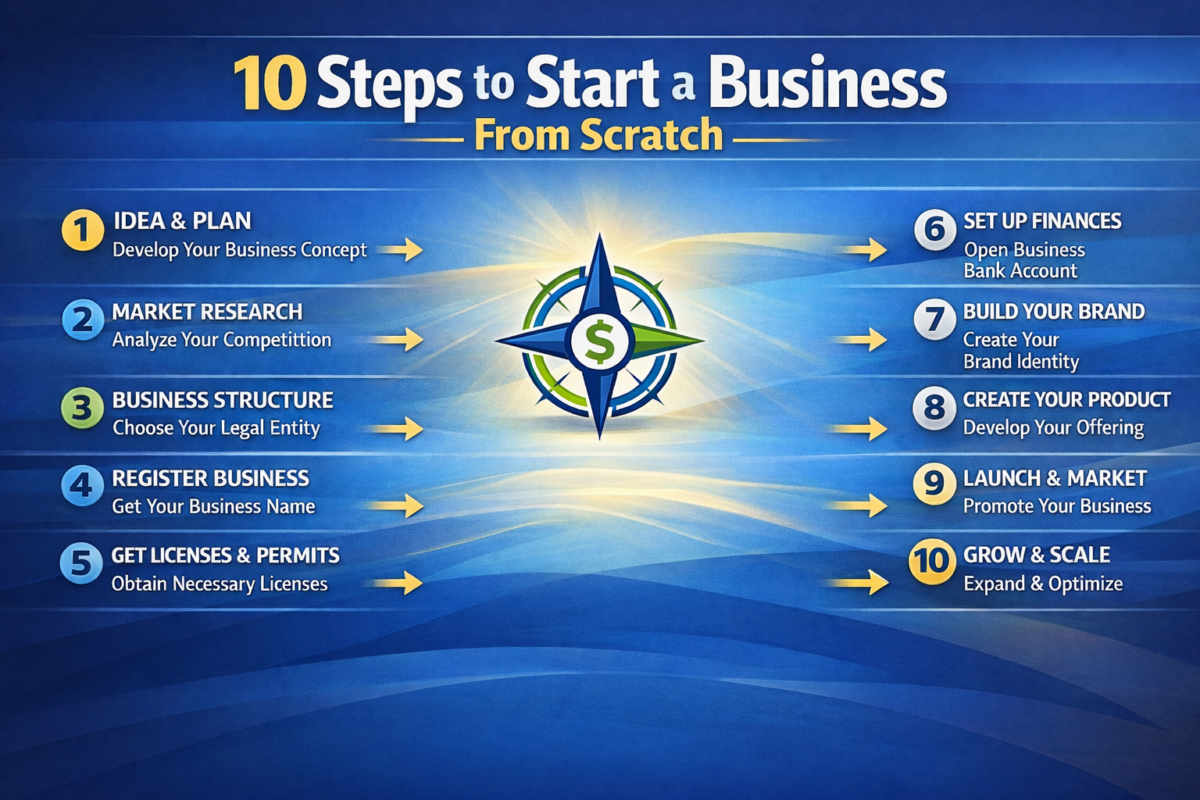
Starting a business from scratch sounds overwhelming — but it's really just a sequence of decisions. Make them in the right order and you'll avoid the most common (and expensive) mistakes. Here are 10 steps that actually work.
Step 1: Identify a real problem
Every successful business solves a problem people are already paying to solve. Don't start with "I want to make money" — start with "who has a problem I can solve better, faster, or cheaper?"
Look for problems in your own life, your community, or industries you know well. The best business ideas come from direct experience.
Step 2: Define your offer
Your offer is what you sell, who you sell it to, what result they get, and what it costs. Write it in one sentence: "I help [specific person] achieve [specific result] through [specific service/product] for [price]."
If you can't write that sentence clearly, your offer isn't ready yet.
Step 3: Validate before you invest
Don't build a website, buy equipment, or form an LLC until you've validated demand. Validation means someone says "yes" with a date and payment — not just "that sounds interesting."
Talk to 10–20 potential customers. Offer a beta version at a discount. If you can't get one paying customer, more investment won't fix the problem.
Step 4: Get your first paying customer
Your first customer is the most important milestone. It proves the offer works, gives you feedback, and funds the next step.
Don't wait for a perfect website or logo. Sell directly — through your network, local groups, or marketplaces that already have buyers. Read: How to Start a Business With No Money.
Step 5: Set up basic operations
Once you have paying customers, set up the minimum viable operations:
- A way to get paid (Venmo, PayPal, Stripe, or Square)
- A simple intake process (form or email template)
- A delivery checklist so every customer gets the same quality
- A basic contract or service agreement
Step 6: Handle money and taxes from day one
Open a separate bank account for business income and expenses — even if you're a sole proprietor. Set aside 25–30% of every payment for taxes. Track all income and expenses in a simple spreadsheet.
Check your debt-to-income ratio before taking on any business debt: DTI Calculator.
Step 7: Choose a business structure
Most new businesses start as sole proprietors. Once you have consistent revenue and meaningful liability risk, consider forming an LLC. Full breakdown: Do You Need an LLC to Start a Business?
Step 8: Build a simple marketing system
You don't need a complex marketing strategy. You need one reliable channel that consistently brings in leads. Options: referrals, local SEO, one social platform, or a simple email list. Pick one, master it, then add more.
Step 9: Deliver consistently and collect reviews
Consistent delivery builds reputation. After every project, ask for a review or testimonial. Three genuine testimonials are worth more than a $1,000 ad campaign for a new business.
Step 10: Reinvest and scale deliberately
Once you have consistent revenue, reinvest in the things that create more revenue: better tools, more marketing, or hiring help. Don't scale expenses before you scale revenue.
Use our Net Worth Calculator to track how your business is building your overall financial picture.