Most business plans are written to satisfy a requirement — a bank loan, an investor pitch, an SBA application — and then never looked at again. A good business plan does the opposite: it forces you to think through your business model rigorously, identify your assumptions, and create a roadmap you'll actually use. This guide gives you a lean, practical framework that covers what matters.
Where to Start When Opening a Business: 6 Steps To Prepare You | NerdWallet
Source: NerdWallet
One-Page vs. Full Business Plan
Choose based on your purpose:
- One-page business plan (Lean Canvas): For early-stage businesses, internal planning, and testing assumptions. Takes 1–2 hours to complete. Best for most startups.
- Full business plan (15–30 pages): Required for SBA loans, traditional bank loans, and most investor pitches. Takes 2–4 weeks to complete properly.
Start with the one-page version to validate your model, then expand to a full plan when you need external financing.
The 8 Essential Sections
1. Executive Summary
Write this last. It's a 1–2 page summary of the entire plan. Include: what your business does, who it serves, your competitive advantage, and your funding request (if applicable). This is the only section most investors read first — make it compelling.
2. Company Description
What problem does your business solve? Who are your customers? What's your business model (how do you make money)? What stage are you at (idea, pre-revenue, existing revenue)?
3. Market Analysis
Define your Total Addressable Market (TAM), Serviceable Addressable Market (SAM), and Serviceable Obtainable Market (SOM). Be specific — "the global fitness market is $100 billion" is not useful. "There are 45,000 households within 10 miles of our location with household income above $75,000" is useful.
Include competitor analysis: who are your top 3–5 competitors, what do they charge, and what's your differentiation?
4. Products and Services
Describe what you sell, your pricing, your cost to deliver, and your gross margin. If you have intellectual property, patents, or proprietary processes, mention them here.
5. Marketing and Sales Strategy
How will you acquire customers? What's your customer acquisition cost (CAC) and lifetime value (LTV)? What channels will you use — paid ads, SEO, referrals, partnerships, direct sales?
6. Operations Plan
Where will you operate? What equipment, technology, or facilities do you need? Who are your key suppliers? What does your production or service delivery process look like?
7. Management Team
Investors bet on teams as much as ideas. Highlight relevant experience, skills, and any advisors or board members. If you have gaps (no technical co-founder, no sales experience), acknowledge them and explain how you'll address them.
8. Financial Plan
The most scrutinized section. See the financial projections section below.
Financial Projections That Hold Up
Three financial statements are required for a full business plan:
Income statement (P&L)
Revenue − Cost of Goods Sold = Gross Profit. Gross Profit − Operating Expenses = Net Income. Project monthly for Year 1, quarterly for Years 2–3.
Cash flow statement
More important than the P&L for early-stage businesses. A profitable business can still run out of cash if customers pay slowly or you have large upfront costs. Show when cash comes in and goes out.
Balance sheet
Assets = Liabilities + Equity. Required for bank loans and investors. Shows the financial health of the business at a point in time.
Key assumptions to document
- Monthly customer growth rate and basis for that assumption
- Average revenue per customer
- Gross margin percentage
- Fixed vs. variable cost breakdown
- When you expect to reach break-even
Lenders and investors will stress-test your assumptions. Build a conservative case (50% of projected revenue) and show the business still survives.
Common Business Plan Mistakes
- Unrealistic financial projections. "We only need 1% of the market" sounds conservative but is often wildly optimistic. Build projections from the bottom up (how many customers can you realistically acquire per month?).
- No competitive analysis. "We have no competition" is a red flag, not a selling point. Every business has competition — direct, indirect, or the status quo.
- Ignoring cash flow. Many profitable businesses fail because they run out of cash. Model your cash flow carefully, especially if you have long payment cycles.
- Too long. A 60-page business plan signals you haven't done the work of distilling what matters. Aim for 15–25 pages for a full plan.
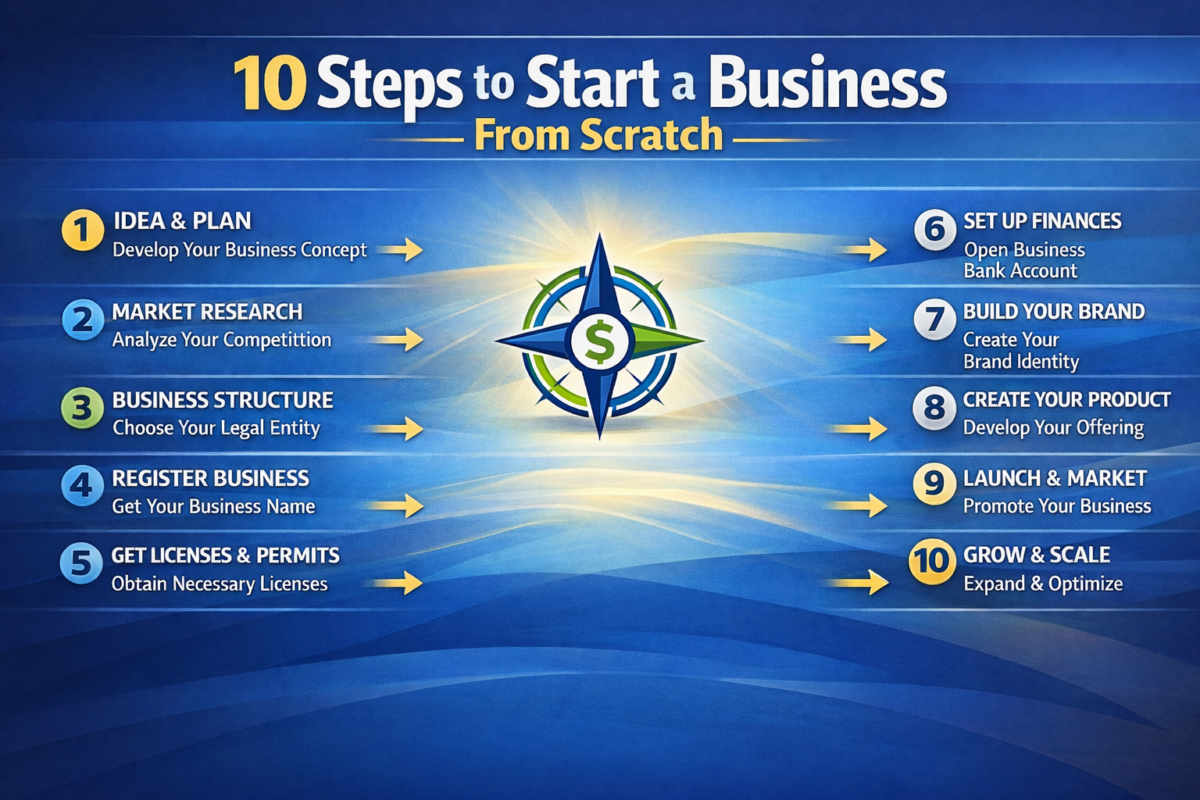
Also see our guide on how to start a business from scratch for the full launch sequence.
FAQ
Do I need a business plan to start a business?
No — but you need to think through what a business plan forces you to think through. A one-page Lean Canvas takes 2 hours and covers the critical questions. Skip it and you're likely to discover expensive problems later.
How long should a business plan be?
For internal use: 1–5 pages. For bank loans: 15–25 pages. For investor pitches: a 10–15 slide deck plus a 1-page executive summary is often more effective than a full written plan.
Do banks require a business plan for a small business loan?
SBA loans always require a business plan. Traditional bank loans typically require one for amounts above $50,000. Microloans and some online lenders may not require a formal plan.
What's the difference between a business plan and a pitch deck?
A business plan is a detailed written document. A pitch deck is a visual presentation (10–15 slides) used for investor meetings. Both cover similar content but in different formats for different audiences.
A business plan is a thinking tool as much as a document. The process of writing it — especially the financial projections — forces you to confront assumptions you might otherwise gloss over. Write it for yourself first, then adapt it for whoever needs to read it.