














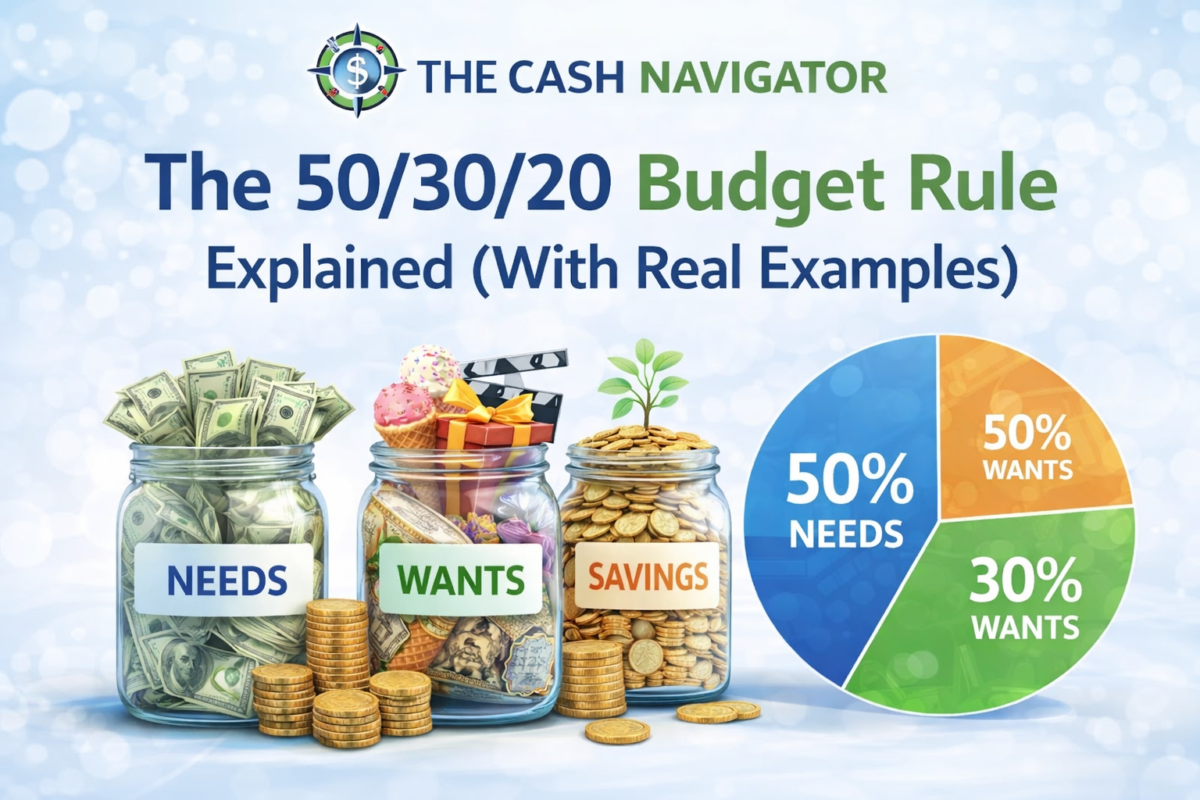








If you’re struggling financially, learning how to save money fast when you’re broke can help you regain control of your finances and start building a safety cushion. This article provides 8 practical tactics to free up cash and start saving immediately, even when you feel broke. We cover quick wins like cutting small daily expenses (for example, brewing coffee at home saves ~$100/month), canceling unused subscriptions, and negotiating bills. Each tactic includes specific math: weekly targets and real examples to hit a savings goal (say $500 in 4 weeks). We also link to related posts Live Happy Using the 50/30/20 Budget Rule and The 30-Day Money Reset (Fix Your Finances Fast) and cite trusted sources (Bankrate, Investopedia, etc.) to back up the advice. By following these steps and tracking progress (see table and chart below), you’ll convert small actions into big savings quickly, even on a tight budget.
Why Fast Savings Matter When You’re Broke
When money is tight, unexpected costs can be devastating. Delaying savings means missed opportunities. Financial advisors emphasize that even small daily savings add up fast. For instance, Bankrate notes that skipping a $4 coffee each workday saves about $80 per month. Over time, these add up. Starting a tight-budget savings plan immediately can build an emergency cushion to cover car repairs, medical expenses, or a gap between jobs. According to Investopedia, paying off high-interest debt while saving is wise – reducing debt frees up income that can be moved into savings. Likewise, the U.S. median household earns ~$84,000; if you make much less, maximizing every dollar is crucial. The tactics below focus on low-cost or no-cost changes that can yield rapid results.
1. Track Every Dollar (Even Small Expenses)
Start by tracking all spending for a week. Write down every purchase – gas, coffee, snacks, apps, etc. This reveals “money leaks” even when you’re broke. You might discover you spent $50 on lattes or $30 on streaming you forgot about. Knowing these numbers helps you set a weekly savings target (e.g. $125).
- Action: Use a simple spreadsheet or free app to log daily expenses.
- Example: If you spend $5/day on coffee and skip it 5 days a week, you save $25/week (≈ $100/month). That alone hits a good portion of many $500 monthly savings goals. Automation aids here too – set up a round-up app (like Qapital) that saves spare change daily; as Bankrate notes, automation ensures you save without thinking.
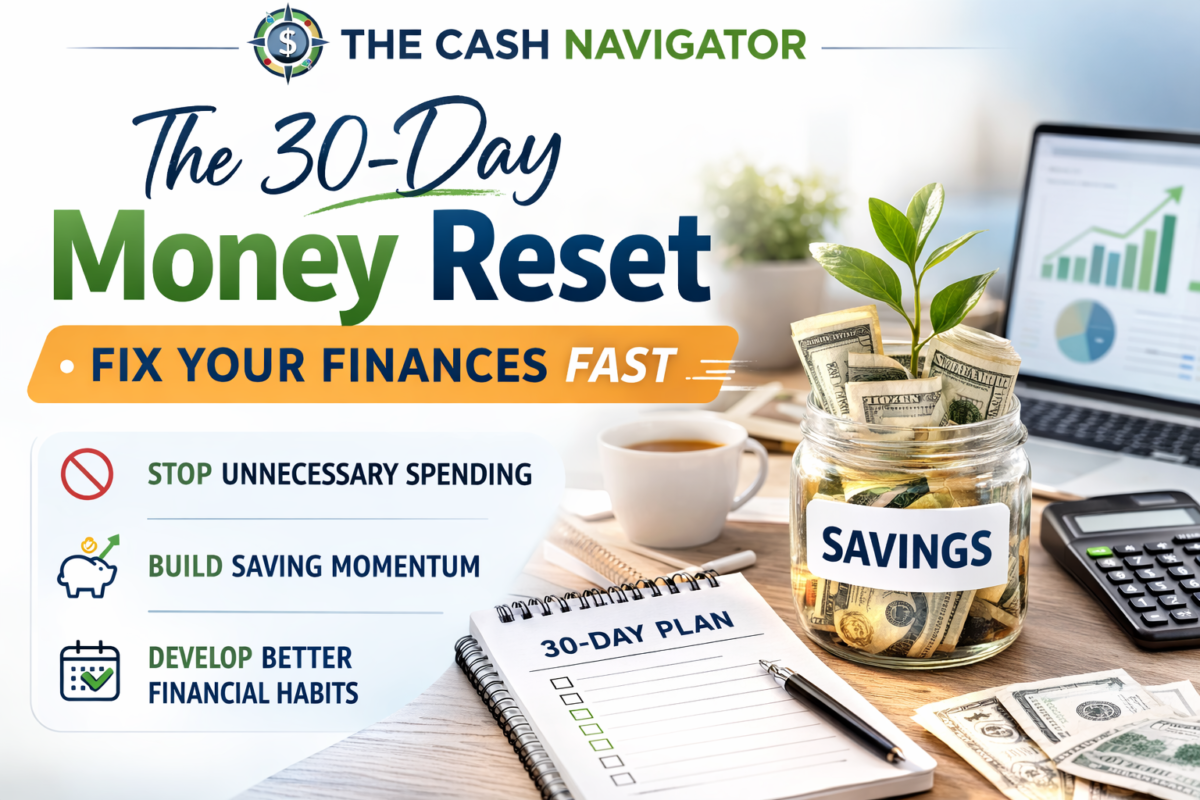
If you need a structured reset, check out our 30-Day Money Reset guide to quickly stabilize your finances.
2. Slash Variable Costs to Save Money Fast When You’re Broke
Cutting non-essential day-to-day expenses yields quick wins. Living broke doesn’t mean you can’t enjoy life, but try low-cost alternatives:
- No eating out: Cook at home or pack lunches. A Bankrate tip: making one restaurant meal a week instead of eating out can save $60–$100/week.
- Skip the coffee shop: Brew at home. At $4 per coffee, skipping it 5 days saves $20/week. That’s ~$80/month into savings.
- Use public transport or carpool: If 52% of trips are under 3 miles, consider walking, biking, or transit to cut gas and parking costs by $20–$40 weekly.
- Entertainment hacks: Choose free fun – library movies, streaming with friends, game nights. Even small changes matter: paying with cash can curb impulse buys.
Example Math: Cutting one $15 restaurant meal per week and two $5 coffees yields ~$45/week. Combined over 4 weeks, that’s $180 saved – enough to cover many emergencies.
3. Eliminate Unnecessary Expenses (Subscriptions & Bills)
Recurring charges silently drain your budget. Take a hard look at bills:
- Cancel unused subscriptions: Many Americans pay for services they rarely use. Cancel a $10 streaming and a $15 gym fee to save $25/month ($100 per 4 weeks).
- Negotiate or change plans: Call your cable, internet, or phone provider. Often they have unadvertised discounts (AutoPay, paperless billing) that cut bills 10–20%.
- Trim utilities: Adjust thermostat by 2–3 degrees (saves ~5–10% of heating/cooling cost). Unplug chargers and use LED bulbs to reduce electric bills by $5–$10/month.
Example Math: Cutting $25/month from subscriptions and $10/month on utilities nets $35/month (~$8.75/week). Over a month, this adds to roughly $140 toward your goal.
4. Automate Your Savings (Forced Saving)
Turn saving into a non-negotiable “expense.” Treat a portion of your income like a bill:
- Direct deposit to savings: If possible, split your paycheck deposit (for example, 10%) directly into savings or a separate account. As Investopedia advises, “pay yourself first” to build savings before spending.
- Round-up apps: Use fintech apps (Qapital, Acorns) that round purchases up to the next dollar and stash the difference. Even $0.50 per transaction can become $60–$100 extra per month (2–3 transactions daily).
- Save found money: Put windfalls (tax refund, bonus, birthday cash) straight into savings. If you save $500 of a tax refund now, that’s your emergency fund 40% closer.
Example Math: Automating $50 every week from checking to savings yields $200/month. Combined with round-ups (~$30/month), you auto-save $230. This ensures progress even if you forget to manually save each week.
5. Use Cash-Back and Coupons (Earn While You Spend)
Stretch every dollar with cash-back apps and coupons:
- Cash-back apps: Sign up for Rakuten, Ibotta, or Fetch Rewards. They give you ~1–5% back on groceries, online shopping, gas, etc. For a $300 grocery bill, 5% back is $15 saved.
- Cash-back credit cards: If you use credit responsibly (pay in full), cards like Discover or Citi® Double Cash offer up to 1–5% back on purchases. Even a modest grocery budget can generate $5–$10 monthly back.
- Coupons and discount codes: Use Honey or RetailMeNot for online purchases. NerdWallet-style research suggests coupon users can save up to $1,465 per year. Even clipping just a few coupons per week can save $20–$30, adding ~$80/month to your bottom line.
Example Math: Earning $10/week via cash-back (shopping + bills) yields $40/month. Pair that with $20/month in coupon savings, and you add roughly $60 in fast savings.
6. Generate Quick Income (Sell Unused Items & Gig Work)
Even if you’re broke, you likely have underutilized assets:
- Sell stuff online: List used clothes, electronics, or furniture on eBay, Facebook Marketplace, or Poshmark. Selling 5 old items at $20 profit each = $100 in one week.
- Quick gigs: Offer services you can do with no startup cost (dog walking via Rover, babysitting, yard work, or part-time rideshare). A few hours of gig work can earn $50–$100 in a week if done smartly.
- Cash incentives: Take advantage of sign-up bonuses (banks, apps). Sometimes apps pay you for your first grocery receipt or for trying a survey app. These may not be large, but every extra $10 helps when broke.
Example Math: Selling items for $100 one week, plus doing a couple hours of gig work for $80, adds $180 that week. If directed wholly into savings, that’s a huge fast boost.
7. How Do You Save Money Fast When You’re Broke?
Break your big monthly goal into small weekly goals. A simple table helps:
| Week | Target Saved This Week | Cumulative Saved | Notes |
|---|---|---|---|
| Week 1 | $125 | $125 | Cancel subs, cut coffee |
| Week 2 | $125 | $250 | No takeout, use coupons |
| Week 3 | $125 | $375 | Automate $50 + sell items |
| Week 4 | $125 | $500 | Garage sale or extra gig |
Table: Example weekly savings targets toward a $500 4-week goal (adjust goals to your income and needs).
Assumptions: The exact savings will vary by individual income, location, and living costs. Strategies are based on average U.S. spending habits and may need adjustment for your situation.
By following these steps, even very small daily adjustments can quickly add up to real savings, helping you move from living paycheck-to-paycheck toward financial stability.
Frequently Asked Questions
Can you really save money fast when you’re broke?
Yes, although it may start with very small amounts. Saving money when you’re broke is less about large deposits and more about plugging small spending leaks. Skipping a $5 daily purchase, canceling an unused subscription, or cooking at home instead of ordering food can quickly free up $100–$300 per month. The key is redirecting that money into savings instead of letting it disappear into other spending.
What is the fastest way to save money right now?
The fastest way to save money is to cut variable spending immediately. Focus on expenses you can change today:
• eating out
• delivery services
• daily coffee purchases
• impulse online shopping
Even cutting $15 per day in discretionary spending can create $450 in savings within one month.
How much should I try to save if I’m living paycheck to paycheck?
If you’re struggling financially, start with a small, achievable target. Many financial planners suggest building a starter emergency fund of $500 to $1,000 before focusing on larger goals. Saving even $20 to $50 per week can reach this milestone within a few months.
Is it better to pay off debt or save money first?
In many cases, the best approach is to do both at the same time. Build a small emergency fund first so unexpected expenses don’t push you deeper into debt. Then divide extra money between paying down high-interest debt and continuing to grow your savings.
What are the biggest money leaks for people on tight budgets?
The most common spending leaks include:
• unused subscriptions
• food delivery and takeout
• convenience purchases (coffee, snacks, impulse buys)
• high-interest credit card debt
• recurring charges people forget about
Identifying and eliminating just a few of these expenses can free up hundreds of dollars each month.
How quickly can saving money improve my financial situation?
Small improvements can happen very quickly. Many people notice positive changes within 30 days once they start tracking spending and cutting unnecessary costs. Building a full emergency fund may take several months, but the feeling of financial control often appears much sooner.
Final Thoughts
Being broke doesn’t mean you’re bad with money. It usually means you’re operating with less margin, and small mistakes carry bigger consequences.
The good news is that saving money fast rarely requires dramatic life changes. Most of the time it’s about fixing a handful of leaks:
• recurring subscriptions you forgot about
• convenience spending (coffee, delivery, takeout)
• unused items sitting around your house
• small habits that slowly drain your cash flow
Even small adjustments compound faster than people realize.
Cutting $10 per day in spending creates about $300 per month in extra cash. Redirect that money toward savings and suddenly the idea of a $500 emergency cushion or a $1,000 starter fund becomes realistic.
Financial stability rarely happens overnight. But momentum builds quickly once you begin controlling where your money goes.
The key to save money fast when you’re broke is simple:
track your money, cut the leaks, and redirect the difference toward savings.
Do that consistently and your financial situation can start improving within weeks.
Related Guides on The Cash Navigator
If you’re working on improving your finances, these guides will help you build momentum:
How to Save $5,000 in One Year
Learn a realistic strategy to gradually build a larger savings cushion.
The 30-Day Money Reset
A step-by-step challenge designed to quickly stabilize your finances.
How Much Emergency Fund Should You Have?
Understand the ideal safety net for unexpected expenses.
How to Save Money on a Low Income
Practical strategies for building savings when every dollar counts.
Live Happy Using the 50/30/20 Budget Rule
A simple budgeting framework that keeps spending balanced.

