



















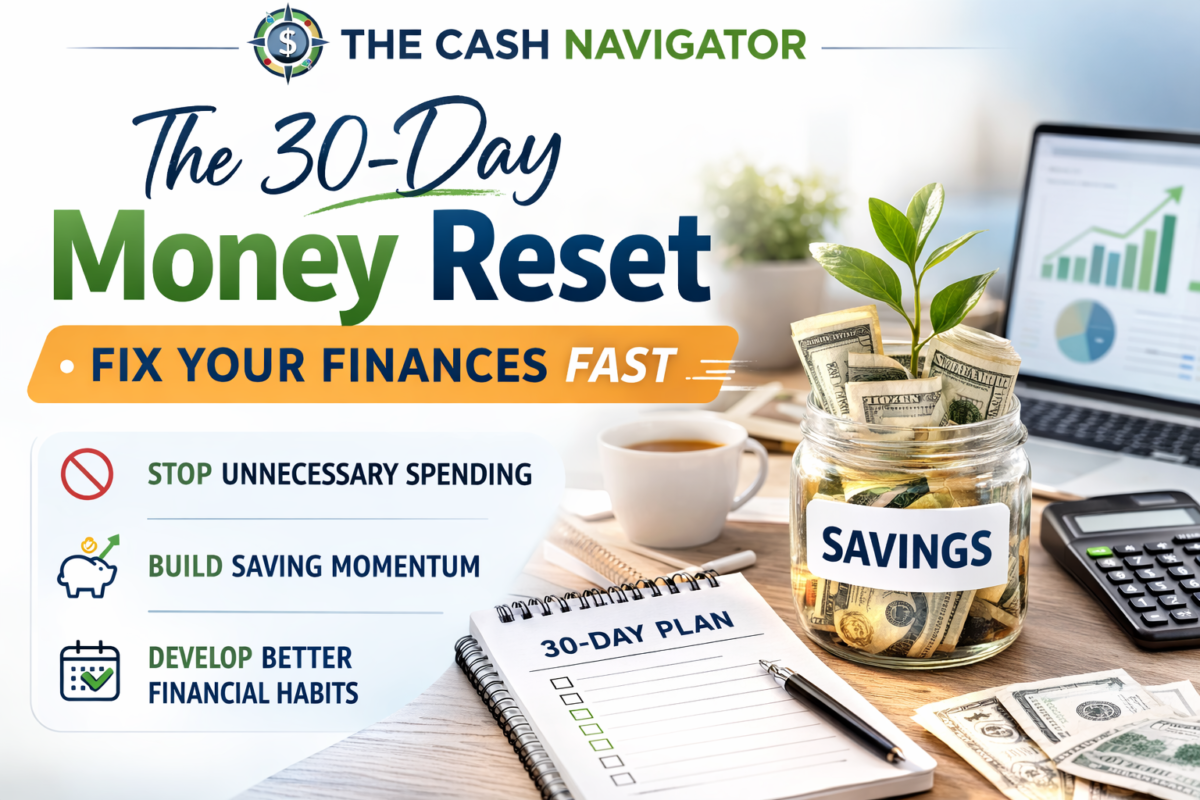

If your finances feel chaotic, the fastest way to regain control is with a short, focused reset.
A 30-day money reset is a one-month plan designed to help you:
• stop unnecessary spending
• build momentum toward savings
• develop better financial habits
Instead of vague goals like “I should save more,” you follow a simple weekly system that forces real action.
Even small changes can produce big results. For example, replacing a $6 daily coffee with home-brewed coffee saves about $180 per month.
By the end of this guide, you’ll have a clear plan to:
- track your spending
- cut unnecessary costs
- automate your savings
- increase your income
If you’re just starting your financial journey, this plan works well alongside our guides on How Much Money You Should Save Each Month and the 50/30/20 Budget Rule Explained.
Why a 30-Day Money Reset Works
Short-term financial challenges are powerful because they create urgency.
When you give yourself a clear time frame, your brain treats the goal like a mission rather than a vague idea.
Financial experts often recommend delaying impulse purchases for 30 days before buying something unnecessary. This pause dramatically reduces emotional spending.
Government consumer resources also emphasize two simple steps that drive most financial progress:
- create a budget
- pay yourself first
You can explore those fundamentals through the FTC’s financial literacy tips:
The 30-day reset simply compresses those ideas into a focused one-month plan.
Week 1 – Track Every Dollar (Quick Budget Audit)
The first step to the 30-Day Money Reset is brutally simple:
track every dollar you spend.
For the first few days of the reset, record every purchase.
Coffee.
Snacks.
Subscriptions.
Parking.
Everything.
Most people are shocked by what they discover.
Tracking spending is the fastest way to identify financial leaks.
Action Step
Create a simple budget using this easy example:
| Category | Monthly Budget | Actual Spending |
|---|---|---|
| Housing | $2000 | $1200 |
| Food | $500 | $400 |
| Subscriptions | $20 | $62 |
| Savings | $461 | $200 |
Once you see where your money goes, set a weekly savings target.
A good starting point is:
$125 per week
That equals $500 saved in 30 days.
Week 1 – Cancel Subscriptions and Lower Bills
Next, attack your recurring expenses.
Many people unknowingly pay for subscriptions they barely use.
A 2022 consumer survey found that the average American spends about $219 per month on subscriptions.
Streaming services, apps, gym memberships, software subscriptions, and digital tools all add up.
Review your monthly charges and cancel anything unnecessary.
Example
Canceling just two subscriptions:
- Streaming service → $15
- Magazine subscription → $10
Savings: $25 per month
Over a year, that equals $300 saved.
Even small changes accelerate your reset.
You can learn more about reducing subscription costs from Synchrony Bank:
Week 2 – Slash Daily Spending
Week two focuses on daily spending habits.
Small purchases feel harmless but add up quickly.
If you spend:
- $5 on coffee
- $10 on lunch
That’s $15 per day.
Over a month, that’s roughly $450.
Your Challenge for the 30-Day Money Reset
For one week:
- no restaurant meals
- no coffee shops
- no impulse purchases
Cook meals at home and brew coffee yourself.
Financial firms like Fidelity recommend occasional no-spend challenges as an effective way to reset habits.
Example Savings
Skipping:
- two $15 lunches
- four $5 coffees
can save $60 per week.
That’s $240 per month.
Week 3 – Automate Your Savings
By week three, you’ve already identified where money leaks out.
Now the focus shifts to automation.
Set up an automatic transfer from your checking account into a savings account immediately after payday.
Treat savings like a bill.
When savings become automatic, discipline becomes unnecessary.
Use Round-Up Savings
Many banks allow you to round up purchases.
Example:
$6.75 purchase → rounded to $7.00
$0.25 goes to savings.
Apps and banking tools can automate this process.
NerdWallet explains how round-up savings mimic the old “spare change jar” method:
If you make 4–5 purchases daily, this can easily add $60–$120 per month.
Week 3 – Increase Your Income
Cutting spending helps, but earning more accelerates everything.
Nearly half of Americans now have a side hustle.
Even a small income boost can dramatically increase savings.
Simple Side Income Ideas
- selling unused items online
- freelance gigs
- tutoring
- delivery apps
- digital product sales
Your goal:
earn $100 during week three.
Saving that entire amount instantly boosts your monthly progress.
If you’re exploring additional income streams, check out our guide to Side Hustles That Actually Make Money.
Week 4 – Review Your Progress
The final week of the 30-Day Money Reset is about reflection and adjustment.
Calculate how much you saved during the reset.
Did you hit your goal?
If not, identify small tweaks:
- cancel one more subscription
- skip one more takeout meal
- add one more side gig hour
Even if you saved $300–$500, the reset is still a success.
More importantly, you’ve created habits that continue long after the challenge ends.
6 Key Tactics That Make 30-Day Money Reset Work
Here’s a quick summary of the core strategies:
Create a Mini Budget
Track every dollar and set a weekly savings target.
Cancel Unused Subscriptions
Two canceled subscriptions can save $100+ annually.
Reduce Restaurant Spending
Cooking at home can save hundreds per month.
Automate Your Savings
Schedule transfers so saving happens automatically.
Use Round-Up Tools
Spare change apps can add $60–$120 monthly.
Increase Income Temporarily
Side hustles provide a fast savings boost.
Example 30-Day Savings Plan
| Week | Weekly Savings Target | Total Saved |
|---|---|---|
| Week 1 | $125 | $125 |
| Week 2 | $125 | $250 |
| Week 3 | $125 | $375 |
| Week 4 | $125 | $500 |
By the end of the month, you’ve saved $500 or more.
What to Do After the Reset
A 30-Day Money Reset is just the beginning.
Once you’ve built momentum, the next step is long-term saving systems.
Continue your progress with these guides:
• How Much Money Should You Save Each Month
• How to Save $5,000 in One Year
• Best High Yield Savings Accounts
These strategies will help turn your short-term reset into long-term financial growth.
Final Thoughts
Money problems rarely come from one large mistake.
They come from hundreds of tiny habits repeated daily.
The 30-Day Money Reset works because it interrupts those habits and replaces them with better ones.
Track your spending.
Cut what you don’t need.
Automate savings.
Earn a little extra.
Do that for just one month, and your financial trajectory begins to change.
And once momentum builds, saving money becomes far easier than you imagined.

