How you pay yourself as a business owner isn't just a personal finance question — it's a tax strategy decision. The method you use depends on your business structure, and choosing the wrong approach can cost you thousands in unnecessary taxes. Here's the complete breakdown.
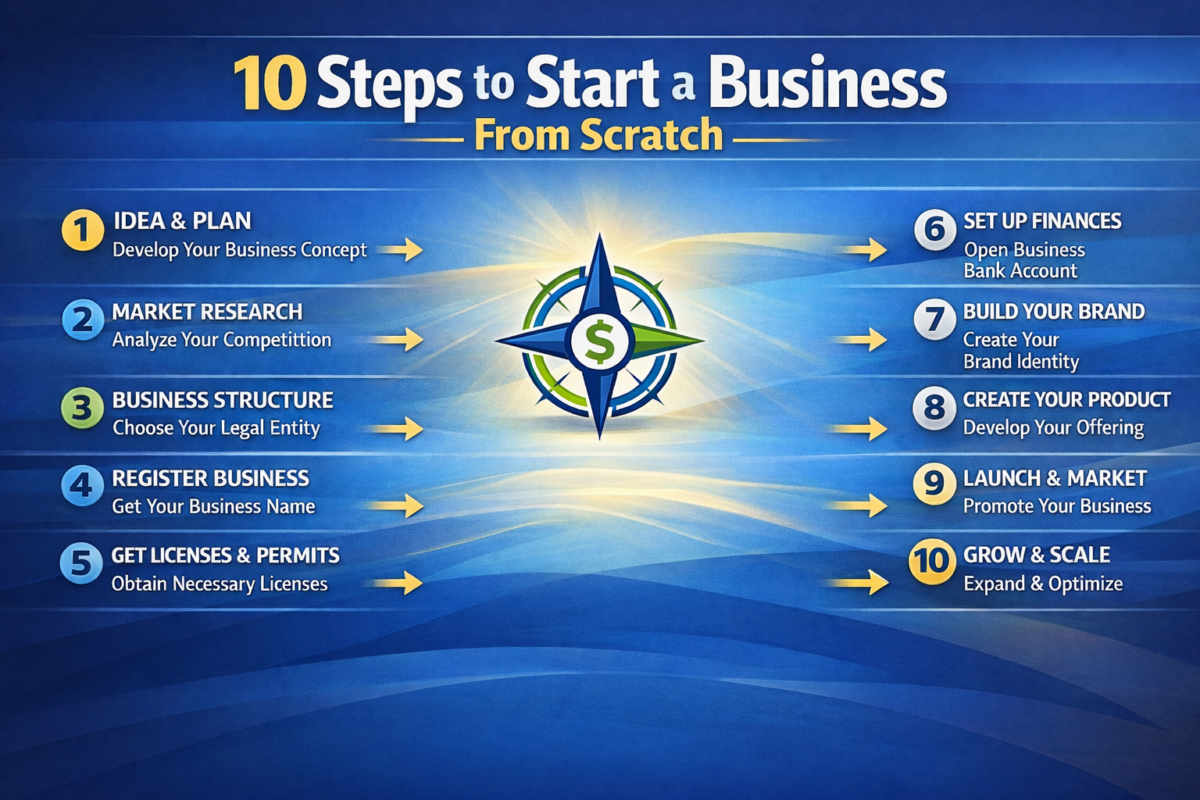
Where to Start When Opening a Business: 6 Steps To Prepare You | NerdWallet
Source: NerdWallet
Payment Methods by Business Structure
| Structure | Payment Method | Self-Employment Tax? |
|---|---|---|
| Sole proprietor | Owner's draw | Yes, on all net profit |
| Single-member LLC | Owner's draw | Yes, on all net profit |
| Multi-member LLC | Guaranteed payments or distributions | Yes, on guaranteed payments |
| S-corporation | Salary + distributions | Only on salary portion |
| C-corporation | Salary + dividends | Only on salary portion |
Sole Proprietor and Single-Member LLC
As a sole proprietor or single-member LLC, you pay yourself through an owner's draw — simply transferring money from your business account to your personal account. There's no payroll, no W-2, and no withholding.
The tax reality: all net profit from your business is subject to self-employment tax (15.3%) plus ordinary income tax, regardless of how much you actually draw. Even if you leave $50,000 in the business, you owe SE tax on it.
Quarterly estimated taxes
Without an employer withholding taxes, you must pay quarterly estimated taxes to avoid penalties. Due dates: April 15, June 15, September 15, January 15. Aim to pay at least 90% of your current year tax liability or 100% of last year's tax (110% if income above $150K).
S-Corporation Strategy
The S-corp election is one of the most powerful tax strategies for profitable small businesses. Here's why: in an S-corp, you pay yourself a reasonable salary (subject to payroll taxes) and take the remaining profit as distributions (not subject to self-employment tax).
S-corp tax savings example
| Sole Proprietor | S-Corporation | |
|---|---|---|
| Net business profit | $120,000 | $120,000 |
| Reasonable salary | N/A | $60,000 |
| Distribution | N/A | $60,000 |
| Self-employment/payroll tax | $16,956 (on $120K) | $9,180 (on $60K salary only) |
| Annual tax savings | — | $7,776 |
Requirements for S-corp election:
- Must be a US citizen or permanent resident
- Maximum 100 shareholders
- Must pay yourself a "reasonable salary" — the IRS scrutinizes S-corps that pay no salary to avoid payroll taxes
- Additional administrative costs: payroll processing ($50–$150/month), separate business tax return (Form 1120-S)
The S-corp election typically makes financial sense when net profit exceeds $40,000–$50,000/year. Below that, the administrative costs often outweigh the tax savings.
See our guide on LLC vs. other business structures for the full comparison.
C-Corporation
C-corps pay a flat 21% corporate tax rate on profits. Owners pay themselves a salary (subject to payroll taxes) and can receive dividends (taxed at 15–20% qualified dividend rate). This creates potential double taxation — but also planning opportunities.
C-corps make sense for: businesses seeking venture capital, companies planning to reinvest most profits at the lower corporate rate, and businesses with multiple classes of stock. For most small businesses, an S-corp or LLC is simpler and more tax-efficient.
How Much to Pay Yourself
There's no universal answer, but here's a practical framework:
- Cover your personal needs first. Calculate your actual monthly personal expenses and make sure your draw covers them.
- Leave a cash buffer in the business. Keep 2–3 months of operating expenses in the business account before increasing your draw.
- Pay yourself consistently. Irregular draws make budgeting harder. Set a regular "salary" even if you're a sole proprietor — transfer the same amount on the same day each month.
- Increase as the business grows. Reinvest in the business first, then increase your compensation as revenue and profit grow sustainably.
Use our Net Worth Calculator to track your personal financial progress as your business income grows.
FAQ
Can I pay myself a salary as a sole proprietor?
Not technically — sole proprietors don't have "salaries." You take owner's draws. But you can set up a regular transfer schedule that functions like a salary for budgeting purposes.
What's a "reasonable salary" for an S-corp?
The IRS requires S-corp owner-employees to pay themselves a salary comparable to what they'd pay someone else to do the same work. There's no fixed formula, but a salary of 40–60% of total compensation (salary + distributions) is a common guideline. Consult a CPA for your specific situation.
Do I need a separate business bank account?
Yes — always. Mixing personal and business finances creates accounting nightmares, complicates taxes, and can pierce the liability protection of an LLC or corporation. Open a dedicated business checking account from day one.
When should I hire a CPA?
When your net business profit exceeds $30,000–$40,000/year, a CPA typically saves more in taxes than they cost in fees. The S-corp election alone can save $5,000–$15,000/year for profitable businesses.
How you pay yourself is a tax decision as much as a personal finance decision. Sole proprietors keep it simple with owner's draws. Profitable businesses (above $40K–$50K net profit) should seriously evaluate the S-corp election. Whatever structure you use, keep business and personal finances completely separate and pay your quarterly estimated taxes on time.