

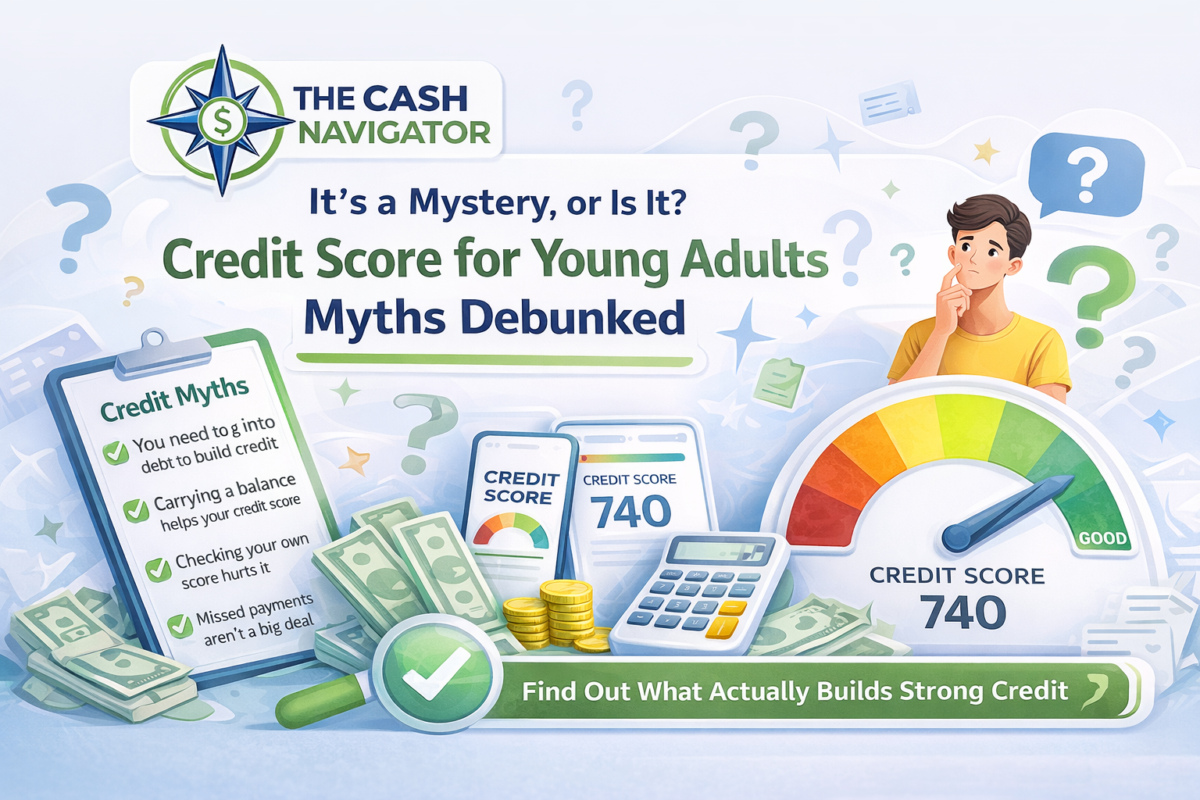
For many people in their late teens and twenties, a credit score for young adults feels like one of those financial things you are somehow supposed to understand without anyone ever really explaining it. You hear that it matters. You hear that you need “good credit.” You hear warnings not to mess it up. But until you apply for an apartment, need a car loan, want a better credit card, or try to finance something important, it can still feel abstract.
That is why so many young adults end up learning about credit at the worst possible moment. A landlord runs a screening. A lender quotes a rough rate. A starter card application gets denied. Suddenly, what felt like a distant money topic becomes very real. The issue is not just that credit feels confusing. It is that myths about credit are everywhere, and bad advice can get expensive fast.
This article breaks down the biggest myths around a credit score for young adults, what actually matters, and what you should do if you want to build strong credit without sabotaging your budget. The goal is not to make credit sound mysterious or intimidating. The goal is to make it practical.
Why a Credit Score Feels Like a Mystery in the First Place
The reason a credit score for young adults feels so confusing is simple: most people are introduced to the consequences before they are taught the system. Credit becomes important when life starts asking for proof. That might mean a landlord checking your file, a lender pricing a car loan, or a bank deciding whether you qualify for a card with decent terms.
That is also why young adults often treat credit as either a huge scary trap or as something they can ignore until later. Neither approach works well. Credit is not everything, but it does affect how flexible and affordable your financial options are. A stronger profile can help you qualify more easily and pay less in interest over time, while a weaker one can make borrowing more expensive right when your income is still developing.
If you are still working on the rest of your financial system, it helps to build that alongside your credit habits. Good places to start are Best Budgeting Apps in 2026 and The 50/30/20 Budget Rule Explained (With Real Examples), because budgeting and cash flow problems are often what damage credit in the first place.
Myth #1: “I’m Young, So My Credit Score Doesn’t Matter Yet”
This is one of the most expensive myths around a credit score for young adults. People often assume credit only matters when they are ready to buy a house. In reality, it can matter much earlier. Renting an apartment, opening accounts, financing a vehicle, or qualifying for a better credit card can all become easier or harder depending on your profile.
That does not mean you need to obsess over your score every day. It means you should stop thinking of credit as a future-only problem. Early adulthood is the phase when small habits start to compound. A thin but clean credit history is far better than waiting too long and then scrambling when a real-life decision suddenly depends on it.
Myth #2: “You Need to Go Into Debt to Build Credit”
No. You need to use credit responsibly, not recklessly. A strong credit score for young adults is not built by borrowing a lot of money. It is built by showing that you can handle credit consistently and on time.
You do not need to finance random purchases you cannot afford. You do not need to run up card balances just to “show activity.” In fact, those habits can hurt more than help. Responsible credit-building is usually much less dramatic than people think. It often looks like one starter card, one or two predictable expenses, low balances, and on-time payments.
If you do not yet have any credit history, there are safer ways to begin. Depending on your situation, that may include becoming an authorized user on a trusted person’s card, using a secured card, or considering a credit-builder loan. Those tools are designed to help establish payment history without forcing you into unnecessary debt.
Myth #3: “Carrying a Balance Helps Your Credit Score”
This myth refuses to die, and it costs people real money. Carrying a balance does not help a credit score for young adults just because the balance exists. What helps is using credit responsibly and paying on time. In fact, paying your balance in full each month can be better than carrying a balance because it helps you avoid finance charges and can keep you farther from your credit limit.
This is one of the easiest myths to fix because the practical move is straightforward: use the card, keep spending controlled, and pay it off. You do not need to pay interest to prove you know how credit works. Paying interest just makes the lesson more expensive.
If that changes how you think about credit cards, good. A card is not extra income. It is a payment tool that reports your behavior.
Myth #4: “One Missed Payment Isn’t a Big Deal”
For a credit score for young adults, this mistake can hit harder than people expect. A single late payment can create damage that lasts far longer than the initial mistake. That is why autopay, calendar reminders, and simple spending limits matter so much. A missed payment is often not a discipline problem as much as a systems problem.
If your cash flow is already tight, protecting your score gets harder. That is one reason you should not treat credit-building as separate from saving. A small buffer can keep a rough week from turning into a late payment. That is why it makes sense to pair credit work with guides like How to Save Your First $1,000 and How Much Emergency Fund Should You Have?.
The practical lesson is simple: do not give yourself a chance to “remember later.” Set your payments up so the right thing happens automatically.
Myth #5: “Checking Your Own Credit Score Hurts It”
This myth keeps people in the dark. Monitoring your own credit score for young adults is smart. Knowing where you stand is better than guessing, and regular monitoring helps you catch errors, missed payments, or suspicious activity sooner.
What you want to avoid is confusing personal monitoring with repeated applications for new credit. Watching your own score is not the same thing as applying for five new accounts in a month. One helps you stay informed. The other can make your file look riskier if you are overdoing it.
It is also worth checking your credit reports directly, not just the score number you see in an app. Your report is where you can catch inaccurate information or signs of fraud. If you want a legitimate place to review your reports, the official place to get free credit reports is AnnualCreditReport.com. That is useful because a credit score for young adults can only be as accurate as the information being reported.
Myth #6: “More Credit Cards Automatically Ruin Your Score”
Not exactly. The bigger issue for a credit score for young adults is not simply the number of cards. It is how you use them. Opening too many accounts too quickly can create problems, but one or two well-managed accounts are not the same as reckless overapplication.
In fact, a second card can sometimes help if it is opened strategically, used lightly, and managed well. Why? Because total available credit affects utilization. If you keep spending the same but have more total room, your utilization ratio may improve. That said, this only helps if the extra account does not tempt you to spend more.
Young adults should think in terms of control, not collection. You do not need a wallet full of cards. You need a small setup you can manage with zero drama.
Myth #7: “A High Limit Means I Should Use It”
This is where a lot of people quietly wreck a credit score for young adults. A higher limit is not permission. It is capacity. If you treat the full limit like spendable cash, you can end up with high utilization, expensive interest, and a payment burden that spills into the rest of your budget.
Starter credit is easiest to manage when you keep purchases boring and predictable. Gas. A streaming bill. A small subscription. Groceries within a fixed budget. The moment credit becomes a lifestyle upgrade instead of a controlled tool, you invite unnecessary risk.
If you struggle with overspending or emotional spending, fix that before you chase rewards or higher limits. Read How to Save Money Fast When You’re Broke and The 30-Day Money Reset. Those habits protect your score indirectly by improving how you handle cash in the first place.
Myth #8: “If I Have No Credit History, I’m Starting at Zero”
Not quite. A thin file and a damaged file are not the same thing. A credit score for young adults often starts with limited information, not with a terrible reputation. That is actually a much better place to begin than people think.
What matters is how you establish the first layer of history. If you start with a beginner-friendly card, keep balances low, and pay on time, you can begin building a solid file without making your financial life more complicated than it needs to be.
This is one reason secured cards and beginner cards can make sense. They are not glamorous, but they are practical. A flashy rewards product you cannot qualify for is useless. A simple card that reports on-time payments is far more valuable at the beginning.
Myth #9: “Bad Early Credit Mistakes Follow You Forever”
A weak credit score for young adults can absolutely be improved. That does not mean it rebounds overnight, and it does not mean mistakes are harmless. But it does mean the situation is fixable.
If your score is already lower than you expected, focus on the order of operations:
- bring every account current
- stop new late payments from happening
- pay down high revolving balances
- avoid unnecessary new applications
- review your reports for errors
The smartest move here is not panic. It is consistency. Credit repair myths often tempt people into complicated or sketchy “solutions,” but most real improvement comes from fewer mistakes, lower balances, and time.
What Actually Builds a Strong Credit Score for Young Adults
Once you strip away the myths, building a credit score for young adults comes down to a handful of habits that are boring but effective.
Pay on time, every time
This is the foundation. If you do nothing else well, do this well.
Keep utilization low
Low balances are easier on your budget and usually better for your profile than maxing out a small starter card.
Start with the right product
A secured card, student card, beginner card, or authorized-user arrangement can be enough to start.
Use autopay and reminders
Do not rely on memory when one missed payment can do real damage.
Do not apply randomly
Apply with a purpose. Desperation applications create noise.
Protect your cash flow
A strong credit score for young adults is much easier to build when you are not constantly one bad week away from falling behind.
A Smart 60-Day Plan
If you want a practical way to improve your credit score for young adults, keep the next 60 days simple.
Week 1
- check your score through a reputable source
- review your credit reports
- pick one starter product if you need one
- set up autopay immediately
Weeks 2–4
- put one or two planned purchases on the card
- keep the balance low
- pay before the balance gets uncomfortable
- avoid any extra applications
Weeks 5–8
- watch your spending behavior
- make sure the card is not changing your lifestyle upward
- stay current on every bill
- keep building savings in parallel
The point is not to outsmart the system. The point is to create a clean pattern that future lenders can trust.
Why Budgeting Still Matters More Than Most Credit Advice Admits
A credit score for young adults is easier to improve when the rest of your money life is not a mess. Budgeting is what keeps you from relying on credit for normal expenses. Savings are what keep emergencies from becoming late payments. Income growth is what gives you breathing room instead of forcing you to live on borrowed money.
That is why credit-building should be paired with broader personal finance habits. A few useful related reads are Best Budgeting Apps in 2026, Side Hustles That Actually Make Money, and What Is a Good DTI? (Debt-to-Income Ratio, And How to Lower Yours Fast).
If your actual problem is not just a thin file but also too much monthly pressure, no credit trick will fully solve that. You need margin. Credit gets healthier when your money system gets healthier.
Final Thoughts
The phrase credit score for young adults sounds more mysterious than it should. Yes, the scoring models have details behind them. Yes, the number can feel weirdly important for something no one taught clearly. But the core truth is simple: good credit is usually the result of steady habits, not secret knowledge.
Do not let myths make you passive. You do not need to go into debt to build credit. You do not need to carry a balance. You do not need five cards. You do not need to panic if your score is not where you want it yet.
You need a manageable setup, on-time payments, low balances, a little savings, and enough budgeting discipline that credit never becomes your emergency plan. That is how a strong credit score for young adults gets built in real life.
Related Articles on The Cash Navigator
- Best Budgeting Apps in 2026 (Top Picks That Actually Work)
- The 50/30/20 Budget Rule Explained (With Real Examples)
- How to Save Your First $1,000 (Step-by-Step Beginner’s Guide)
- How Much Emergency Fund Should You Have?
- How to Save Money Fast When You’re Broke
- The 30-Day Money Reset (Fix Your Finances Fast)
- Side Hustles That Actually Make Money
- What Is a Good DTI? (Debt-to-Income Ratio, And How to Lower Yours Fast)
External Sources
- NerdWallet: How to Build Credit From Scratch at Any Age
- NerdWallet: Credit Score Ranges Explained
- NerdWallet: Real Ways to Improve Your Credit Fast
- Forbes Advisor: Best Beginner Credit Cards
- Forbes Advisor: Best Credit Cards for Young Adults
- CFPB: How to Rebuild Your Credit
- FTC: Free Credit Reports
- FTC: Free Weekly Credit Reports
- myFICO: What’s in Your FICO Score
Leave a Reply